Two large suitcases, two cabin bags, backpacks, and shopping acquired in Delhi or Agra can put pressure on sedan luggage space.
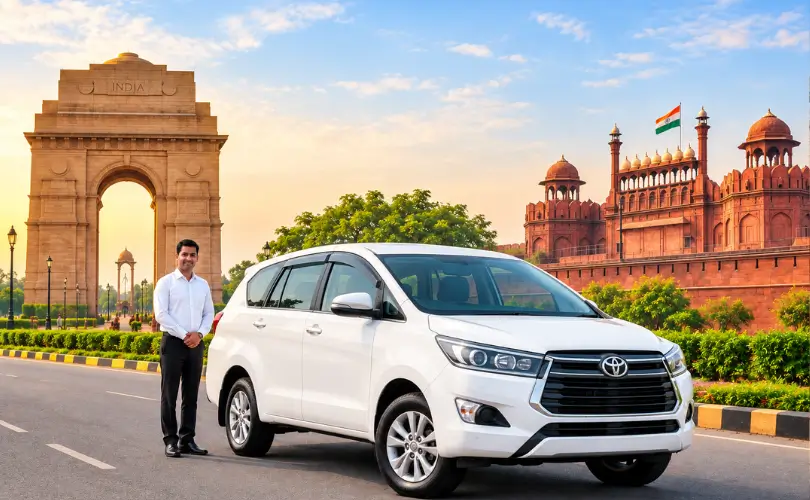
An Innova becomes useful in that situation.
Three adults should generally choose an Innova-type vehicle rather than trying to fit passengers and luggage into a smaller car.
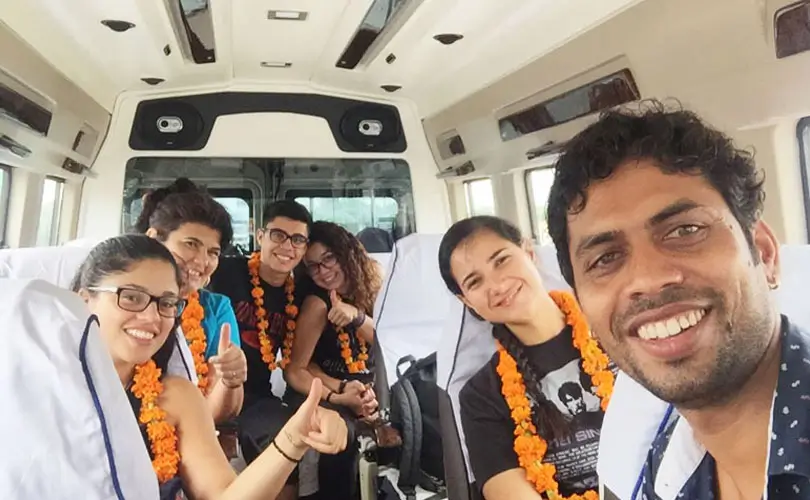
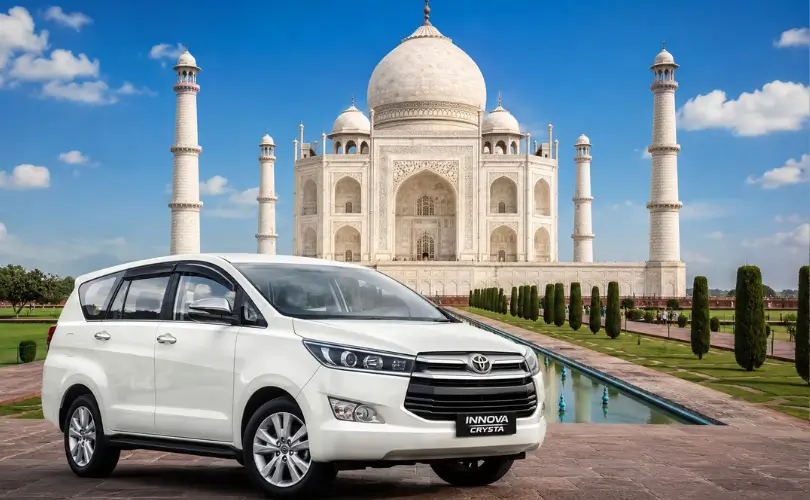
An Innova Crysta Agra to Jaipur transfer provides additional comfort for travelers who will spend eight or more hours combining road travel with sightseeing stops.
Families can also benefit from the extra space.
Senior travelers may appreciate the ability to sit more comfortably between walking-heavy monument visits.
For four international adults with substantial luggage, a larger vehicle is normally the sensible choice even if the fare is higher.
The vehicle should have effective air conditioning.
This is particularly important because Rajasthan can be very hot for much of the year.
Travelers should also keep a small day bag inside the cabin containing passports, medication, water, chargers, and anything needed during sightseeing.
Large luggage can remain secured in the vehicle while guests visit Fatehpur Sikri and Abhaneri, but passports, cash, and high-value electronics should remain with the traveler.
The road journey from Agra to Jaipur is one of the most useful sightseeing transfers in North India. Instead of treating the day as several hours inside a car, international visitors can stop at Fatehpur Sikri and Abhaneri Chand Baori before reaching Jaipur. The route connects Mughal architecture, rural Rajasthan, and one of India's most striking historic stepwells in a single travel day.
A direct Agra to Jaipur private transfer covers approximately 240 kilometres, depending on the starting hotel, final Jaipur accommodation, and road used. Without sightseeing, travelers should generally allow around four to five hours of driving under reasonable conditions. Once Fatehpur Sikri and Abhaneri are included, the complete journey can easily require eight to ten hours from hotel departure to hotel arrival.
That longer duration is not wasted road time. Fatehpur Sikri deserves a proper visit rather than a quick photograph, and Chand Baori at Abhaneri is sufficiently different from the forts, tombs, and palaces elsewhere on the Golden Triangle to justify the detour.
A private car works particularly well for this sector because the traveler does not need to follow a fixed coach schedule. The driver can collect guests from their Agra hotel, carry their luggage throughout the transfer, wait during sightseeing, stop for lunch, and deliver them directly to their Jaipur hotel.
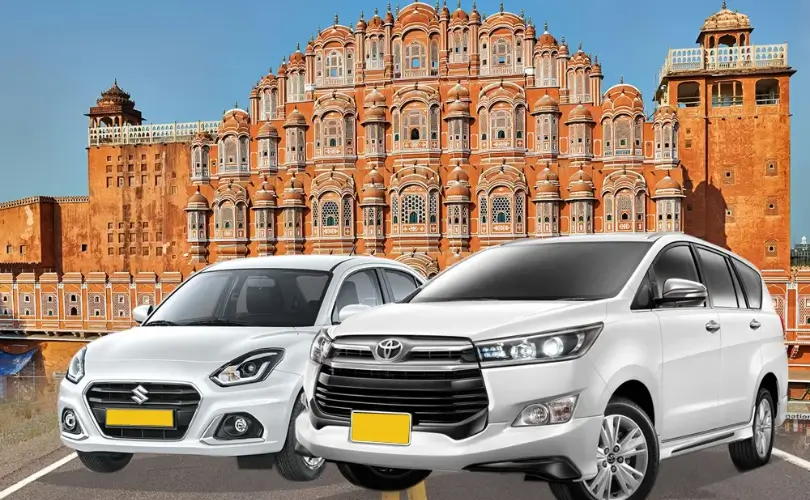
The service can be arranged in a sedan for one or two travelers, an Innova from Agra to Jaipur for passengers wanting additional room, or an Innova Crysta for a more spacious road experience. Vehicle cost depends on the exact route, passenger count, tolls, parking, driver allowance, sightseeing detours, and whether all road charges are included in the quotation.
For international travelers already following the Delhi–Agra–Jaipur circuit, this transfer is far more useful than returning to Delhi or taking a direct journey that bypasses two worthwhile historical sites.
The direct Agra to Jaipur road distance is roughly 240 kilometres, although the final mileage varies according to hotel locations and the route selected by the driver.
A traveler leaving from a hotel near the Taj Mahal does not begin from exactly the same point as someone staying elsewhere in Agra. Similarly, a hotel in central Jaipur requires a different final approach from a resort near Kukas or Amber.
For a direct transfer, approximately four to five hours of driving is a reasonable broad expectation. Road construction, local traffic, weather, meal stops, and congestion while entering Jaipur can increase that time.
Adding Fatehpur Sikri changes the day significantly.
Fatehpur Sikri lies roughly 35–40 kilometres west of Agra and is naturally positioned for travelers heading toward Rajasthan. This makes it one of the easiest major historical additions to an Agra–Jaipur transfer.
A morning departure around 8:00 a.m. is practical for many travelers.
After hotel checkout, the private car can head toward Fatehpur Sikri. Depending on traffic and the exact hotel location, the drive commonly takes around one hour.
A serious visit to Fatehpur Sikri should allow approximately two hours, and travelers with a strong interest in Mughal history may want longer.
After sightseeing, the journey continues toward Rajasthan.
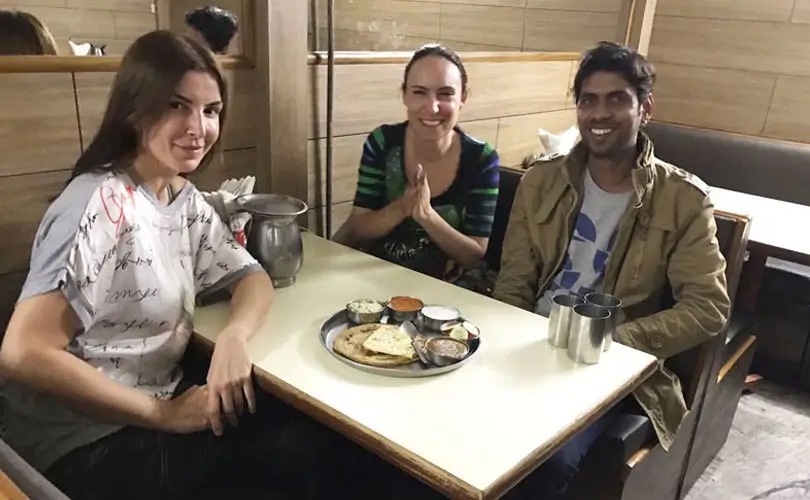
Lunch can be arranged at a suitable restaurant on the route. Travelers should not expect the same density of international-style restaurants found in central Delhi or Jaipur, so choosing a clean and reputable stop is worthwhile.
Abhaneri is reached later in the day.
The village is famous for Chand Baori, a deep stepwell known for its geometric arrangement of thousands of steps. The visit itself usually does not require as much time as Fatehpur Sikri. Approximately 45 minutes to one hour is sufficient for many visitors, although photographers may prefer longer.
After Abhaneri, the car continues toward Jaipur.
With both stops, lunch, normal rest breaks, and traffic, arriving at a central Jaipur hotel around 5:00 p.m. to 7:00 p.m. can be realistic for an 8:00 a.m. departure. Conditions on the day determine the actual arrival time.
This is why major Jaipur sightseeing should generally not be scheduled after the transfer.
Travelers may be tempted to add Amber Fort because it is near Jaipur, but trying to combine Fatehpur Sikri, Abhaneri, Amber Fort, several hours of driving, hotel check-in, and meals creates an unnecessarily rushed day.
Amber Fort deserves a separate morning.
The Agra to Jaipur transfer with sightseeing is already a full experience when Fatehpur Sikri and Chand Baori are visited properly.
Travelers should also keep seasonal daylight in mind. Winter days are shorter, so leaving Agra late can mean reaching Abhaneri or Jaipur close to sunset. Summer provides longer daylight but significantly hotter afternoon temperatures.
An early start is therefore useful in almost every season.
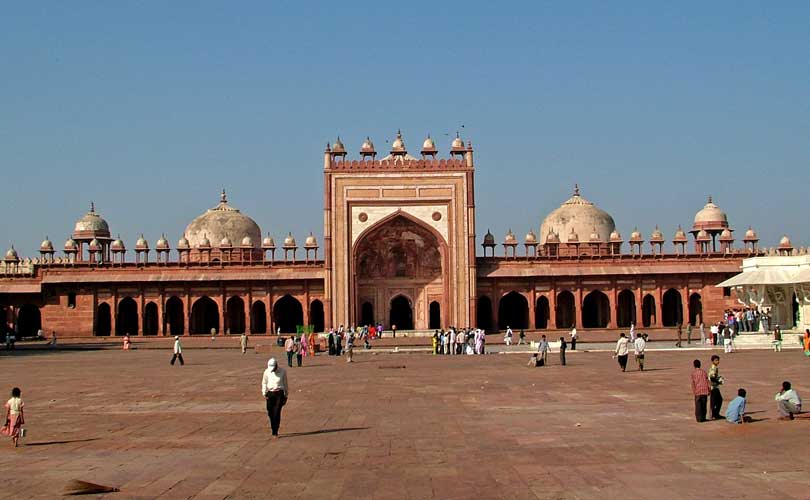
Fatehpur Sikri was established as an imperial Mughal capital during the reign of Emperor Akbar. Its surviving buildings make it one of the most important historical sites between Agra and Jaipur.
The complex is not a single building.
Visitors encounter palaces, courtyards, halls, gateways, and religious structures associated with the Mughal court. The architecture reflects the political and cultural world of Akbar's reign and rewards much more attention than a quick stop between two cities.
The archaeological complex generally operates from sunrise to sunset, although exact entry and ticketing conditions should be checked before travel.
For international visitors, admission to the ticketed monument area is commonly around ₹610 per person. Official ticket rates can change, so travelers should verify the current Archaeological Survey of India tariff close to their visit.
Children's ticket rules and online booking conditions can differ, making current official information preferable to an old screenshot or travel forum post.
One logistical detail often surprises first-time visitors: the private car does not simply drive through the archaeological complex.
Vehicles use designated parking arrangements, and visitors may need to use authorized local shuttle transport or other permitted access between parking and the monument area.
Travelers should therefore allow time for parking, ticket purchase or verification, security, and movement between the parking zone and the monuments.
A private guide at Fatehpur Sikri can be worthwhile because the complex contains numerous structures whose significance is not obvious without historical context.
A guide can explain the function of major courtyards and buildings, Akbar's imperial life, architectural details, and the historical circumstances surrounding the city.
Guide charges vary by language, duration, and service standard. International visitors can broadly budget around ₹1,000 to ₹2,500 or more for private guiding depending on the arrangement.
Travelers should agree on the guide fee before beginning the visit.
Around 90 minutes to two hours is a practical minimum for many visitors. Someone deeply interested in history or architecture can easily spend longer.
The religious area associated with the Jama Masjid and the monumental Buland Darwaza should also be approached respectfully.
Visitors may need to remove footwear in appropriate religious areas and should dress suitably.
Local vendors and unofficial service offers can be persistent. Travelers are not required to buy souvenirs, make purchases, or accept services they did not request.
This is another advantage of having the day's transport arranged in advance. After the visit, travelers know where their driver is waiting and can continue toward Jaipur without negotiating onward transport.
Photography is one of Fatehpur Sikri's attractions.
The red sandstone architecture creates strong geometric lines, large courtyards, carved details, and dramatic gateways. Morning light can be particularly attractive, another reason to visit before the middle of the day.
During hot months, exposed stone courtyards can become extremely warm. Carry drinking water where permitted, wear comfortable footwear, and use sun protection.
A traveler who tries to complete Fatehpur Sikri in 30 minutes may technically have “seen” it but will have missed much of what makes the stop worthwhile.
After the scale of Fatehpur Sikri, Abhaneri provides a completely different visual experience.
The village's principal attraction is Chand Baori, one of Rajasthan's most recognizable historic stepwells. Its deep rectangular structure is lined with thousands of narrow steps descending in repeated geometric patterns.
Stepwells were functional water structures, but many also became important architectural and community spaces.
Chand Baori is particularly striking because of its depth and symmetry.
The structure is commonly associated with King Chanda and is generally dated to around the eighth or ninth century, though historical descriptions can vary in their details.
For modern visitors, the main attraction is the extraordinary geometry visible from the upper level.
Travelers should not expect to freely descend the full staircase. Access to the lower steps is normally restricted for safety and conservation reasons.
The site can generally be visited during daylight hours, commonly around 8:00 a.m. to 6:00 p.m., but operational hours should be confirmed before arrival because local access arrangements can change.
International visitor admission has commonly been in the region of ₹300 per person, while domestic rates are lower. Current ticket pricing should be checked close to the travel date.
A normal visit requires around 45 minutes.
Travelers interested in photography or stepwell architecture may spend approximately an hour.
Near Chand Baori stands the Harshat Mata Temple, an important historical temple site. The surviving structure has undergone changes over centuries, but carved architectural fragments around the area remain interesting.
Visitors should behave respectfully because the temple retains religious significance.
Abhaneri is a village rather than a major tourism city.
Travelers should therefore set expectations accordingly. Facilities can be more basic than those at the Taj Mahal or major Jaipur monuments.
Comfortable footwear is useful, and carrying water in the vehicle is sensible.
The stop is particularly valuable because stepwell architecture is not otherwise a central feature of the standard Delhi–Agra–Jaipur monument circuit.
Delhi presents Sultanate, Mughal, colonial, and modern landmarks.
Agra is dominated by Mughal architecture.
Jaipur presents Rajput forts, palaces, observatories, and historic urban design.
Chand Baori Abhaneri adds another architectural tradition entirely.
This variety makes the detour more worthwhile than simply adding another palace to an already palace-heavy itinerary.
A direct transfer and a sightseeing transfer should not be expected to cost exactly the same amount.
A direct Agra to Jaipur private car involves point-to-point transport with normal breaks.
Adding Fatehpur Sikri and Abhaneri requires additional local movement, parking, waiting time, and a longer driver duty.
For a quality one-way direct transfer, a sedan may broadly cost around ₹7,000 to ₹9,000 depending on inclusions.
With Fatehpur Sikri and Abhaneri included, a sedan can reasonably fall around ₹8,500 to ₹11,000.
An Innova-type vehicle may broadly cost approximately ₹11,000 to ₹14,000, while an Innova Crysta can reach around ₹13,000 to ₹17,000 or more for the sightseeing transfer.
These are broad higher-side budgeting figures, not fixed tariffs.
Exact prices depend on pickup hotel, Jaipur drop location, vehicle standard, total mileage, waiting time, tolls, parking, taxes, and current operating costs.
Travelers should ask whether fuel is included.
Tolls should be clarified.
Parking at sightseeing sites should be marked as included or extra.
Driver allowance and interstate operating expenses should also be addressed.
A quote that simply says “Agra to Jaipur taxi ₹6,000” is not enough information for an international traveler to compare services properly.
Ask what the final payable amount will be for the complete Agra Fatehpur Sikri Abhaneri Jaipur transfer.
Monument tickets are usually separate from transportation.
If two international travelers visit Fatehpur Sikri and Chand Baori, they should allow approximately ₹1,800 or more in combined admission costs for the couple based on commonly applicable foreign visitor rates, subject to current official pricing.
Guide services are another separate expense unless explicitly included.
Travelers may choose to hire a guide only at Fatehpur Sikri and visit Chand Baori independently.
Lunch is generally not part of a car-only transfer.
A comfortable restaurant meal on the route may cost approximately ₹600 to ₹1,500 per person, while higher-end dining can cost more.
Drinks, snacks, personal purchases, and tips should also be budgeted separately.
For one or two travelers with moderate luggage, a sedan is usually adequate.
The road journey is long but manageable, and a sedan keeps the Agra to Jaipur private taxi cost lower.
However, international travelers often carry more luggage than domestic weekend passengers.
Two large suitcases, two cabin bags, backpacks, and shopping acquired in Delhi or Agra can put pressure on sedan luggage space.
An Innova becomes useful in that situation.
Three adults should generally choose an Innova-type vehicle rather than trying to fit passengers and luggage into a smaller car.
An Innova Crysta Agra to Jaipur transfer provides additional comfort for travelers who will spend eight or more hours combining road travel with sightseeing stops.
Families can also benefit from the extra space.
Senior travelers may appreciate the ability to sit more comfortably between walking-heavy monument visits.
For four international adults with substantial luggage, a larger vehicle is normally the sensible choice even if the fare is higher.
The vehicle should have effective air conditioning.
This is particularly important because Rajasthan can be very hot for much of the year.
Travelers should also keep a small day bag inside the cabin containing passports, medication, water, chargers, and anything needed during sightseeing.
Large luggage can remain secured in the vehicle while guests visit Fatehpur Sikri and Abhaneri, but passports, cash, and high-value electronics should remain with the traveler.
The Agra–Jaipur sightseeing transfer is long enough that lunch should be treated as part of the day's schedule.
Travelers leaving Agra around 8:00 a.m. and spending approximately two hours at Fatehpur Sikri will normally be ready for a meal before or during the onward journey toward Abhaneri.
A driver familiar with the route can suggest established restaurants with parking and washroom facilities.
International visitors with sensitive stomachs often prefer a busy, well-maintained restaurant rather than an isolated roadside stall.
A meal budget of around ₹600 to ₹1,500 per person is reasonable for a comfortable restaurant, although premium venues can cost more.
Bottled water should have an intact seal.
Travelers with allergies or strict dietary requirements should communicate them clearly.
Vegetarian food is widely available.
Those requiring gluten-free meals, vegan dishes, nut-free preparation, or other specific handling should be more cautious because kitchen practices can differ from those in their home country.
Rest stops should not be viewed as wasted time.
A five-minute break to stretch after several hours of driving can make the journey much more comfortable.
Private transport allows these stops to happen according to the travelers' needs rather than a coach schedule.
At the same time, repeated long stops can push the Jaipur arrival late into the evening.
A good day's schedule balances sightseeing, meals, comfort, and road time.
The quotation should state the complete route:
Agra – Fatehpur Sikri – Abhaneri – Jaipur.
This matters because a direct Agra-to-Jaipur quote may not include the mileage and waiting associated with both sightseeing stops.
The vehicle category should be stated clearly.
Ask whether the quoted amount includes fuel, tolls, parking, driver allowance, interstate costs, and applicable taxes.
Confirm the Agra pickup hotel and exact Jaipur drop property.
If the Jaipur hotel is located far outside the central city, mention it before the final price is issued.
Ask whether the driver waits with the luggage during sightseeing.
Confirm whether professional guide services are included or separate.
Monument tickets should be identified as included or excluded.
Travelers should also check whether any additional charges apply if sightseeing takes longer than expected.
The driver should not be expected to provide professional historical guiding inside monuments unless separately qualified and booked for that role.
For Fatehpur Sikri, a local guide can be arranged independently from the driver.
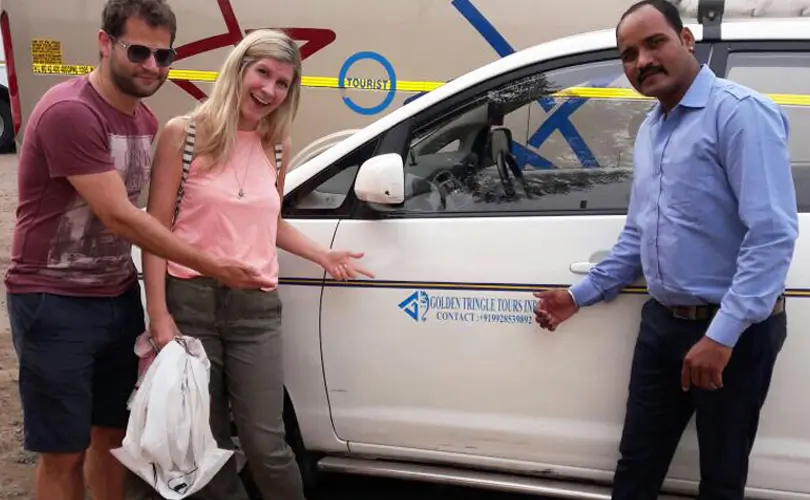
Golden Triangle Tours India can arrange an Agra to Jaipur car with driver via Fatehpur Sikri and Abhaneri as part of a wider Golden Triangle itinerary or as an individual transfer. Providing passenger count, luggage details, hotel names, and vehicle preference before booking allows the route and price to be quoted more accurately.
The strongest version of this transfer is not the fastest one. It is the one that gives enough time for Fatehpur Sikri, allows a comfortable meal break, reaches Chand Baori while there is sufficient daylight, and still delivers travelers to Jaipur at a reasonable hour.
The direct road distance is approximately 240 kilometres, although exact mileage depends on the Agra pickup point, Jaipur hotel, and selected route.
A direct transfer generally requires around four to five hours under reasonable conditions. With Fatehpur Sikri, Abhaneri, lunch, and rest stops, travelers should allow approximately eight to ten hours.
A direct sedan can broadly cost around ₹7,000 to ₹9,000. A sightseeing transfer via Fatehpur Sikri and Abhaneri may cost around ₹8,500 to ₹11,000 for a sedan, with larger vehicles costing more.
For a transfer including sightseeing stops, an Innova-type vehicle can broadly cost around ₹11,000 to ₹14,000. An Innova Crysta may cost approximately ₹13,000 to ₹17,000 or more, depending on inclusions.
Yes. Fatehpur Sikri is one of the most historically important Mughal sites in India and lies naturally along the broader Agra-to-Rajasthan route. Allow roughly two hours for a meaningful visit.
International admission to the ticketed archaeological area is commonly around ₹610 per person. Current official rates should be verified before the visit.
International visitor admission to Chand Baori at Abhaneri has commonly been around ₹300 per person. Ticket prices can change, so current rates should be checked before travel.
Yes. An early Agra departure allows both sites to be visited before continuing to Jaipur. The complete transfer commonly occupies most of the day.
A guide is not mandatory, but professional guiding can add considerable historical context. Private guide costs may broadly range from ₹1,000 to ₹2,500 or more, depending on language and duration.
A departure at approximately 8:00 a.m. or earlier is sensible. It provides sufficient time for Fatehpur Sikri, lunch, Abhaneri, normal road breaks, and arrival in Jaipur during the late afternoon or early evening under reasonable conditions.