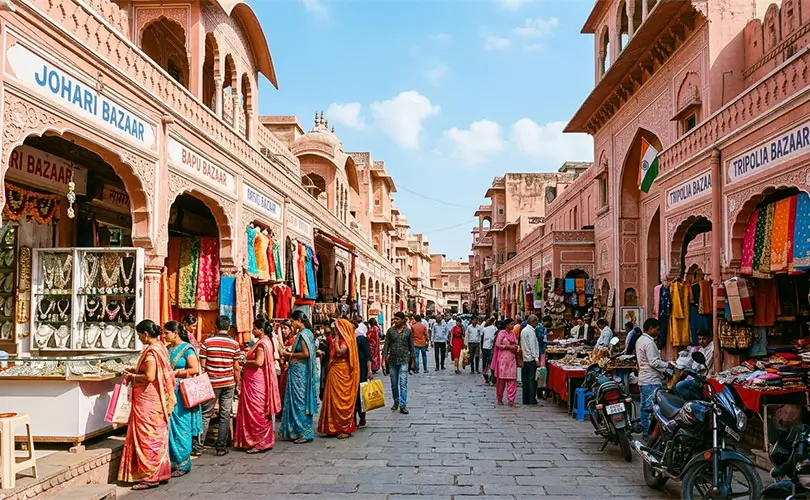
Jaipur is one of the strongest shopping cities on the Golden Triangle route, but the old-city markets are not interchangeable. Johari Bazaar is the natural choice for jewelry and gemstone shopping, Bapu Bazaar suits textiles, footwear and accessible souvenirs, while Tripolia Bazaar is better known for traditional craft items, especially lac bangles and metalware. A traveler who knows these differences can shop more efficiently, spend less time moving between unrelated stores and reduce the risk of buying an expensive item from the wrong type of seller.
The old walled city is busy, colorful and commercial rather than arranged like a modern shopping mall. Shopfronts open directly onto active streets, pedestrians move beside local traffic, and several market lanes connect with one another around Jaipur's historic center. That atmosphere is part of the appeal, but it also means visitors should arrive with a basic idea of what they want to buy. Walking into the first shop after being told that it sells the “best quality in Jaipur” is rarely the strongest way to make a high-value purchase.
A useful Jaipur shopping budget can range from a few thousand rupees for footwear, textiles and small souvenirs to far larger amounts for jewelry, gemstones, carpets or handcrafted objects. Price alone does not establish quality. Travelers buying expensive products should pay attention to material, workmanship, certification, invoice details and return or shipping terms rather than relying only on a seller's verbal assurance.
Johari Bazaar Jaipur is the market most closely associated with jewelry and gemstones. Its location in the historic city makes it easy to combine with sightseeing around Hawa Mahal, City Palace and Jantar Mantar, but travelers interested in serious jewelry purchases should give the market dedicated time rather than attempting to make an expensive decision during a fifteen-minute stop between monuments.
The word “johari” is associated with jewelers, which reflects the market's long commercial identity. Visitors encounter shops dealing in precious and semi-precious stones, gold and silver jewelry, traditional designs and decorative pieces across a wide price range. The difference between a small souvenir purchase and a valuable gemstone transaction is enormous, so the method of buying should change accordingly.
For inexpensive fashion jewelry or a decorative souvenir, a visitor can compare several stores, judge finishing and negotiate where appropriate. For an expensive gemstone, gold item or diamond piece, the buyer should ask much more detailed questions. What stone is being sold? Is it natural, treated, synthetic or composite? What is the weight? What certification accompanies it? What metal purity applies to the setting? Is the price calculated separately for the stone, metal and workmanship?
A seller saying that a stone is “real” is not enough for a high-value transaction.
Travelers should be especially cautious when jewelry is presented as an investment with guaranteed resale value abroad. A tourist should purchase a gemstone because the quality, documentation and price make sense, not because someone promises that it can be resold in London, New York or another city for double the amount.
A proper invoice matters. It should clearly identify the seller, purchased item and amount paid. For higher-value jewelry, relevant specifications should also be documented. Anyone spending a substantial amount should be willing to leave the shop, compare alternatives and return later rather than buying under time pressure.
The market can be active from late morning through evening, but individual store hours vary. Instead of relying on one universal closing time for every jeweler, visitors should aim for roughly 10:30 a.m. onward and check a specific shop directly if they intend to make an important purchase. Old-city business schedules can also change around holidays and local closing days.
A traveler visiting only for casual browsing may need one to two hours, while serious jewelry shopping can easily take half a day because comparison is essential.
International travelers should also decide how payment will be made. Many established stores accept cards and digital payments, but card foreign-exchange charges should be considered. For a major purchase, check the amount on the payment terminal carefully before authorizing the transaction and retain both the invoice and card receipt.
Gemstone shopping in Jaipur can be rewarding, but it is one category where expertise matters more than bargaining skill. A 30% discount does not make an inaccurately represented stone a good purchase.
Step beyond Jaipur’s forts and palaces and discover the craftsmanship that gives the Pink City its character. Explore Johari Bazaar for jewellery, Bapu Bazaar for textiles and souvenirs, and Tripolia Bazaar.
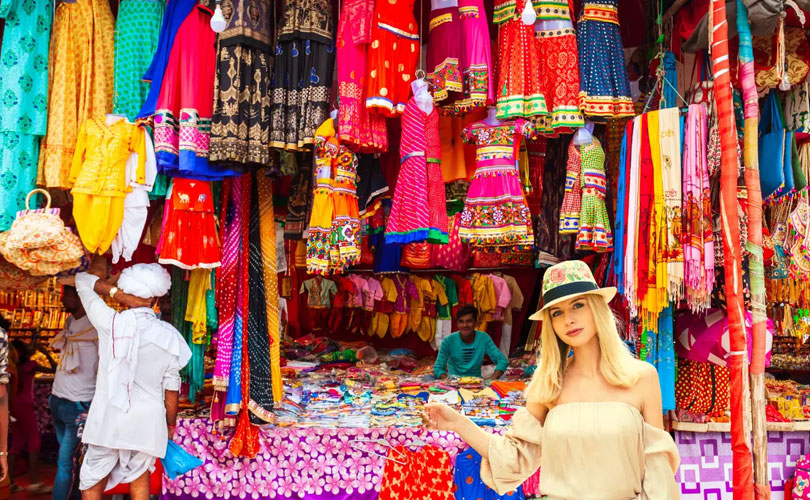
Travelers looking for a broader and generally lower-cost shopping experience will often find Bapu Bazaar Jaipur easier to approach. Current local market information identifies textiles, traditional clothing, quilts, bedsheets and footwear among the market's common shopping categories, with activity concentrated from late morning into the evening.
This is the sort of market where a visitor can arrive without intending to make one major purchase and still leave with several practical souvenirs. Printed fabrics, clothing, bags, footwear, decorative objects and inexpensive accessories make it suitable for travelers who want items that can be packed into a suitcase without a complicated authenticity discussion.
Traditional-style footwear is one of the recognizable categories. Prices depend heavily on materials, finishing and whether the item is handmade or mass-produced. A very inexpensive pair may be perfectly acceptable as a souvenir but should not automatically be treated as high-quality handcrafted footwear.
Textiles require similar judgment. Two printed scarves may look almost identical from a distance while using different fabrics, printing techniques and finishing. Feel the material, check both sides of the print and inspect stitching before deciding.
Bapu Bazaar is also useful for travelers looking for gifts. Smaller textiles, bags and decorative goods are easier to buy for friends and relatives than expensive jewelry because sizing and certification matter less.
A sensible working budget could be ₹1,000 to ₹5,000 for several modest souvenirs, while better textiles or larger purchases can move the amount significantly higher. These are budgeting ranges rather than fixed market prices.
The market is usually busiest later in the day. Current local listings place typical operating hours around 11:00 a.m. to 8:00 p.m., although individual shops can open or close at different times. Visitors seeking a calmer experience can arrive closer to late morning, while those who enjoy stronger market energy may prefer the afternoon.
Recent Jaipur community discussions also suggest that shops often begin opening around 11:00 a.m., with fuller activity closer to midday, reinforcing the practical value of not arriving excessively early.
Allow two to three hours if shopping is a meaningful part of the day. A traveler who enters Bapu Bazaar for thirty minutes will see plenty of merchandise but may not have enough time to compare quality and negotiate calmly.
Tripolia Bazaar Jaipur has a stronger traditional-craft identity than Bapu Bazaar. Current local listings describe it as a historic market associated with lac bangles, brassware, carpets and traditional handicrafts near the City Palace area.
The most distinctive category is lac bangles in Jaipur. Travelers looking specifically for handcrafted bangles should pay attention to the lanes associated with bangle makers rather than assuming that every jewelry shop elsewhere in Jaipur specializes in the same work.
Price depends on design complexity, decoration and whether the set is simple everyday merchandise or more elaborate handcrafted work. Current local shopping guides place lac-bangle prices broadly around ₹200 to ₹3,000 or more, with highly decorative or customized work capable of moving higher. Recent Jaipur community recommendations also point travelers toward the Tripolia area for lac bangles and mention much lower starting prices for simpler pieces, showing why quality and workmanship need to be compared instead of treating one figure as universal.
Visitors should inspect the finishing closely. Decoration should be secure, the inner surface should feel reasonably smooth and the size should be comfortable. Someone buying several sets as gifts should confirm sizes because bangles are not universally interchangeable.
Tripolia is also associated with brass items and decorative metalwork. These products can range from small objects that fit easily into luggage to heavier household pieces. For larger brassware, remember to think about baggage weight before purchasing. A low local price can lose its appeal when several kilograms of excess luggage must be paid for at the airport.
Handcrafted goods should be judged by workmanship rather than perfect machine uniformity. Small variations may reflect manual production, but obvious cracks, weak joints or poorly attached decoration are still quality problems.
Current market guidance lists operating hours broadly around 10:00 a.m. to 7:00 p.m., although individual shops and local weekly closures can vary. Travelers should therefore confirm a particular store if they are making a dedicated trip for one item.
Approximately one to two hours is sufficient for general browsing, while someone ordering custom bangles or comparing several craft shops may need longer.
Bargaining is part of shopping in some Jaipur market situations, but not every price should be treated as an invitation to negotiate aggressively. Large branded stores, clearly fixed-price shops and established jewelers may operate very differently from a small souvenir seller in a market lane.
For ordinary market goods, first determine whether the quoted amount sounds negotiable. Ask calmly whether there is a better price rather than immediately offering a fraction of the amount.
If a seller quotes ₹1,500 for a textile item, an opening counteroffer considerably below the asking price may be reasonable in a bargaining environment, but offering ₹100 simply because tourists are told to negotiate usually wastes time.
The strongest strategy is comparison.
Check two or three similar shops before making a larger purchase. Once the traveler knows that comparable items are being offered around ₹1,000-₹1,300, negotiation becomes more informed.
Do not negotiate for twenty minutes over a product you have no intention of buying. Bargaining should lead toward a realistic transaction rather than becoming entertainment at the seller's expense.
Conversely, do not buy simply because a seller spent time showing products. Walking away is acceptable.
The phrase “final price” is not always literally final, but travelers should recognize when the negotiation has reached a sensible level. Trying to save another ₹50 on a handcrafted item after reaching a fair price can reduce an enjoyable market interaction to unnecessary conflict.
For Jaipur jewelry shopping, bargaining should never replace verification. A lower gemstone price is meaningless if the product is inaccurately described.
Prices in Jaipur vary too much for any market guide to promise one correct figure, but budgeting ranges help travelers recognize the scale of different purchases.
Simple souvenir items may begin around ₹100 to ₹500, while better decorative objects can cost ₹500 to ₹2,000 or more. Scarves and straightforward printed textiles might fall approximately within ₹300 to ₹1,500, while higher-quality fabrics, handwork or larger pieces can cost considerably more.
Traditional-style footwear can often sit around ₹500 to ₹1,500, depending on workmanship and material. Better handmade pairs can move higher.
Lac bangles can begin at only a few hundred rupees and rise into the thousands for detailed sets. Current Tripolia-focused shopping guides provide a broad ₹200-₹3,000+ range, which is useful as a reference but should not be treated as a fixed tariff.
Brass decor can range from several hundred rupees for small items to ₹5,000-₹10,000 or more for heavier or more elaborate pieces.
Jewelry is impossible to place inside one useful range because a fashion accessory and a high-quality precious-stone piece belong to entirely different markets. A tourist can spend ₹500 on decorative earrings or several hundred thousand rupees on serious jewelry.
The rule is straightforward: the higher the price, the stronger the documentation should become.
Every bazaar has its own character. Find fine jewellery and gemstones in Johari Bazaar, textiles and everyday treasures in Bapu Bazaar, and traditional craftsmanship in Tripolia Bazaar.
Small purchases are often easiest with Indian cash, while larger established stores commonly accept cards or digital payments. Travelers should carry enough Indian Rupees for Jaipur markets to handle low-value purchases without withdrawing excessive amounts.
A practical amount might be around ₹3,000 to ₹5,000 in accessible cash for a normal market session when larger purchases will be paid by card. Carrying ₹50,000 in a visible wallet is unnecessary.
International credit cards can work at established stores, but travelers should check whether their bank applies foreign transaction charges. If the payment terminal offers to convert the transaction into the traveler's home currency, read the exchange terms carefully rather than automatically accepting.
UPI is widely visible through QR codes. International visitors using an eligible tourist UPI service can have another payment option, but they should confirm the merchant name and amount before approving any transaction.
Always keep receipts for meaningful purchases.
For jewelry, carpets or expensive handicrafts, ask for a formal invoice rather than accepting only a card slip.
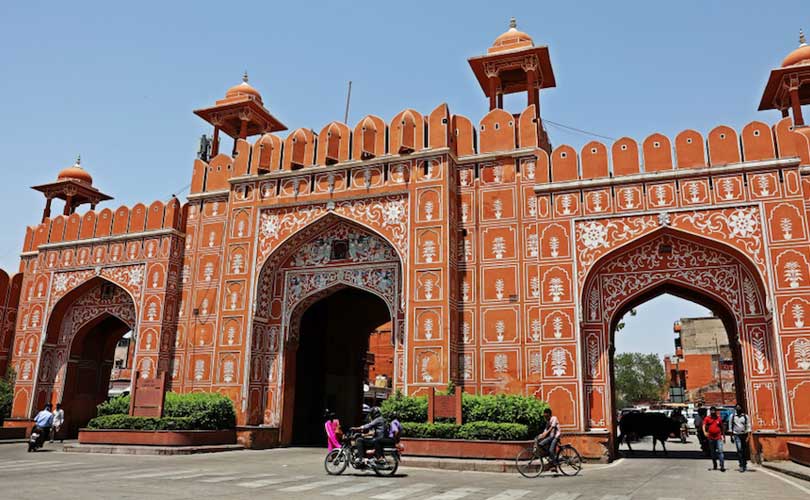
Jaipur's old-city markets sit close to several major attractions, which makes shopping easy to combine with sightseeing if the day is structured properly.
A traveler can spend the morning at Amber Palace and Jal Mahal, return toward the historic center, visit City Palace and Jantar Mantar, and then reserve late afternoon for shopping in Jaipur's old city.
This works particularly well for Bapu Bazaar and Johari Bazaar because market activity is stronger later than monument sightseeing.
Tripolia can also be integrated around the City Palace side of the old city, reducing unnecessary vehicle transfers.
A private driver should not be expected to follow the traveler through every crowded lane. It may be more efficient to arrange a specific pickup point after one or two hours of walking.
Travelers should wear comfortable footwear, keep valuables secure and avoid carrying heavy monument equipment into crowded markets if it can safely remain elsewhere.
The strongest shopping session is deliberate rather than endless. Two or three focused hours can produce better purchases than spending an entire day moving randomly from showroom to showroom.
Textiles are among the easiest items to buy in Jaipur, but they are also a category where two products that look similar from a distance can differ considerably in fabric, printing, stitching and finishing. Travelers shopping for Jaipur block print textiles, scarves, bedsheets, quilts or clothing should inspect the actual product rather than relying only on a seller's description. Begin by feeling the fabric and looking at it in normal light. Check whether the material feels appropriate for the price being quoted, examine the edges and stitching, and look at both sides of printed fabric. Hand-produced work can contain minor variations, but obvious stains, loose seams, damaged sections or inconsistent finishing should not be dismissed as signs of craftsmanship.
Claims about production method deserve attention when they affect the price. A seller may describe an item as handmade, hand-block printed, naturally dyed or produced using another traditional technique. If that description is the reason a product costs substantially more than a mass-produced alternative, ask specific questions about where and how it was made. Travelers do not need to become textile specialists, but they should be able to understand what they are paying for. A higher price should correspond with material, workmanship, technique or design rather than simply a more persuasive sales presentation.
Colorfastness can matter for clothing and household textiles. Buyers can ask about washing instructions before purchasing. Some traditionally produced textiles may require gentle washing, cold water or separate washing initially. A bedsheet that looks excellent in the market but needs specialist care may not suit every traveler. Ask whether shrinkage should be expected and whether the fabric has already been washed or treated.
Measurements are equally important. Terms such as single, double, queen and king can vary between countries and manufacturers. International travelers buying a Jaipur bedsheet or quilt should ask for dimensions in centimeters rather than assuming that a familiar size name will match a bed at home. The same applies to tablecloths, cushion covers and other household textiles.
For clothing, do not rely solely on labels such as small, medium or large. Try the garment on when possible or compare measurements. Alterations may be available at some stores, but the completion time should be confirmed before paying, especially when leaving Jaipur the following morning.
Travelers buying several gifts should also inspect each piece rather than assuming that every item in a stack has identical quality. The display piece may not necessarily be the exact item placed into the shopping bag.
Jewelry requires far more caution than buying a scarf or pair of shoes because the financial consequences of a poor decision can be much greater. Jaipur has a substantial jewelry trade, and Johari Bazaar gemstone shopping can be rewarding for informed buyers, but a vacation should not create pressure to make an investment-level purchase without proper verification.
Start by separating decorative jewelry from precious jewelry. If a traveler likes a pair of inexpensive earrings because of the design, the decision is mainly about appearance, workmanship and price. If the purchase involves gold, diamonds, rubies, emeralds, sapphires or another valuable gemstone, documentation becomes essential.
Ask whether a gemstone is natural or laboratory-created and whether it has undergone treatment. Heat treatment and other processes can affect value, and buyers should know what they are purchasing. For an expensive loose stone, ask about an independent gemological report rather than relying solely on a certificate created by the seller.
Gold jewelry should be checked for appropriate hallmarking and purity information. India uses the BIS hallmarking system for gold and silver jewelry, and the Bureau of Indian Standards provides consumer information on hallmarking. Buyers of valuable precious-metal jewelry should understand the hallmark and verify relevant details rather than accepting a verbal statement about purity.
A common high-pressure sales technique is creating artificial urgency. The visitor may be told that a special price is available only for the next ten minutes, that the stone came directly from a mine, or that the same item would cost several times more in Europe or the United States. None of those statements should replace independent judgment.
Another warning sign is a guaranteed resale story. Travelers should be cautious if they are told that a gemstone purchased in Jaipur can easily be resold at home for a large profit. Buying gemstones in Jaipur should be treated as a retail purchase, not a guaranteed investment strategy.
For a major transaction, compare more than one established seller. Ask for a written quotation and take time to think. A reputable business should be comfortable with a customer considering a high-value purchase rather than demanding immediate payment.
The invoice should identify the item accurately and show the amount paid. Keep certification, payment receipts and seller details together, particularly when the item will be carried internationally.
Know where to look for the things Jaipur does best. Explore the jewellery lanes of Johari Bazaar, the vibrant textiles of Bapu Bazaar and the traditional crafts of Tripolia with a better-planned shopping experience.
A visit to Tripolia Bazaar for lac bangles gives travelers an opportunity to buy one of Jaipur's recognizable traditional craft products without entering the price territory of precious jewelry. Lac bangles are available in a broad range of designs, from relatively simple colored pieces to heavily decorated sets suitable for festive or ceremonial wear.
Sizing should be checked before design. A beautiful bangle that cannot pass comfortably over the hand has little practical value. Travelers buying for themselves should try the pieces carefully, while those purchasing gifts should know the recipient's approximate bangle size whenever possible.
Inspect the inner surface for rough areas that could make the bangle uncomfortable. Decorative stones or embellishments should appear securely attached, and the overall shape should be reasonably even. Handmade work can naturally contain small variations, but visible cracking or loose decoration is a reason to select another piece.
Simple sets can begin at a few hundred rupees, while more elaborate handcrafted lac bangles in Jaipur can cost ₹1,000-₹3,000 or considerably more depending on design and workmanship. Instead of asking only for the cheapest set, compare the quality of decoration and finishing across several price levels.
Travelers carrying bangles internationally should request protective packing. Lac products can be damaged when compressed under heavy luggage, so they should not be placed loose at the bottom of a suitcase. A rigid box or protective container is worth requesting even for relatively inexpensive purchases.
Customization may be possible at specialist sellers, but visitors should ask how long it will take. Someone staying in Jaipur for two more nights has more flexibility than a traveler leaving for Delhi in three hours.
Jaipur shopping is easy when everything fits inside a suitcase. Larger carpets, furniture, artwork or substantial decorative pieces require a different level of caution because shipping becomes part of the transaction.
Before purchasing a large item, ask for the complete delivered price, not only the shop price. Shipping, packaging, insurance, customs charges and taxes at the destination can substantially change the final cost.
The seller should provide a detailed invoice and written description of what is being shipped. Photographs of the exact purchased item can also be useful before it leaves the store. For carpets, document dimensions, material and design. For furniture or decorative pieces, note size, material and any detachable components.
Ask whether shipping is insured and what happens if the item arrives damaged. A statement that “we ship worldwide every day” is not the same as a written shipping policy.
International customs regulations vary. Items involving antiques, wildlife products, restricted materials or culturally protected objects can create serious legal problems. Travelers should never accept vague assurances that customs rules do not matter.
For an expensive Jaipur carpet purchase, paying by a traceable method and retaining all documentation is safer than handing over a large amount of cash without records.
Delivery estimates should also be treated as estimates unless guaranteed in writing. Anyone purchasing an item for a specific event at home should leave adequate time for international transit and customs processing.
The first mistake is buying from the first store visited simply because the salesperson is friendly. Hospitality and product value are separate issues. A visitor can appreciate good service and still compare another shop before spending ₹20,000 or ₹100,000.
The second mistake is allowing a driver, guide or unsolicited helper to control every shopping decision. A recommended shop can be perfectly legitimate, but travelers should understand that commission arrangements may exist in the tourism industry. If the traveler specifically wants Johari Bazaar, Bapu Bazaar or Tripolia Bazaar, that request should be respected instead of being replaced automatically by a private showroom.
The third mistake is believing that every product labeled handmade is unique. Jaipur sells genuine craft products as well as mass-produced tourist merchandise. There is nothing inherently wrong with buying an inexpensive factory-made souvenir if the price reflects what it is. The problem arises when mass-produced merchandise is sold at a premium using an inaccurate story.
The fourth mistake is confusing aggressive bargaining with successful shopping. Saving ₹200 on a product that was already reasonably priced matters less than ensuring that an expensive item is accurately represented.
The fifth mistake is shopping without considering luggage. Textiles are easy to pack, but footwear, brassware, pottery and decorative objects quickly consume space and weight. International airline excess-baggage charges can make an inexpensive purchase unexpectedly costly.
The sixth mistake is waiting until the final hour in Jaipur to buy something important. A traveler who wants a particular textile, gemstone or custom item should shop earlier in the stay so there is time to reconsider, exchange or collect an altered product.
The seventh mistake is losing the receipt. Keep invoices for substantial purchases until the traveler has returned home and confirmed that the item is satisfactory.
Jaipur's old markets are active urban spaces, and travelers should use the same practical awareness they would use in any crowded city. Keep wallets and phones secure, avoid displaying unnecessary cash and carry bags in a way that makes them difficult to open unnoticed.
Traffic deserves particular attention. Streets around the old city can contain cars, motorcycles, cycle rickshaws, auto-rickshaws and pedestrians using the same limited space. Visitors concentrating on shop windows should still look carefully before stepping into the road.
A smaller day bag is preferable to a large backpack when shopping in Jaipur bazaars. Leave passports and unnecessary valuables securely at the hotel when appropriate and carry only the payment methods and identification actually needed.
Heat can also affect the experience. Walking through markets for three hours during the hottest part of the day can become tiring. Late morning or later afternoon is generally more comfortable depending on season, though afternoon markets can be more crowded.
Carry reliable drinking water and wear comfortable footwear. Market streets are not the place for shoes that are suitable only for a hotel lobby.
Women traveling independently can shop in these markets, but ordinary city precautions remain sensible. Persistent sales approaches can usually be handled with a clear refusal and continued walking.
Travelers should also know their pickup location. Old-city congestion can prevent a car from stopping exactly outside a shop, so agreeing on a recognizable meeting point with the driver can save considerable confusion.
Johari Bazaar is the strongest of these three markets for jewelry and gemstones. Travelers making expensive purchases should request proper invoices, check precious-metal purity information and seek reliable certification for valuable gemstones rather than depending only on verbal assurances.
Bapu Bazaar is particularly useful for textiles, traditional-style footwear, bags, clothing, bedsheets and affordable souvenirs. It suits travelers who want several moderate purchases rather than one high-value jewelry transaction.
Tripolia Bazaar is strongly associated with traditional crafts, particularly lac bangles, along with brassware, carpets and other decorative goods. Travelers specifically seeking lac bangles should allow time to compare workmanship and sizes rather than purchasing the first set they see.
Many old-city shops begin opening from roughly 10:00 or 11:00 a.m., with stronger market activity developing toward midday. Bapu Bazaar is commonly active into the evening, while Tripolia generally closes earlier. Individual shop timings and weekly closures vary, so a specific store should be checked before making a dedicated journey.
Bargaining is common for many market products, particularly souvenirs, textiles and some craft items, but not every shop operates the same way. Fixed-price stores may not negotiate. Travelers should compare prices and bargain politely rather than assuming every asking price should be reduced dramatically.
Around ₹3,000-₹5,000 in accessible cash can be practical for small purchases, while larger transactions are generally better handled through traceable payment methods when available. Travelers should avoid carrying unnecessarily large amounts of visible cash in crowded markets.
Jaipur has a major legitimate gemstone and jewelry industry, but tourists should not assume that every stone offered in a market is accurately represented. For a high-value Jaipur gemstone purchase, ask whether the stone is natural or laboratory-created, inquire about treatments, request suitable independent certification and obtain a detailed invoice.
Simple lac bangles in Jaipur can begin at a few hundred rupees, while more elaborate handcrafted sets can reach approximately ₹1,000-₹3,000 or higher. Design complexity, decoration and workmanship have a major effect on price.
Many established sellers offer international shipping for carpets, furniture and decorative items, but travelers should obtain the complete delivered cost, insurance terms, shipping documentation and seller details in writing. Destination-country customs duties may still apply.
Yes. All three can be included in a Jaipur old-city shopping day, particularly when the traveler begins around late morning and allows several hours. A more enjoyable approach is to identify the products wanted in advance, use Johari Bazaar for jewelry, Bapu Bazaar for textiles and souvenirs, and Tripolia Bazaar for lac bangles and traditional craft shopping.