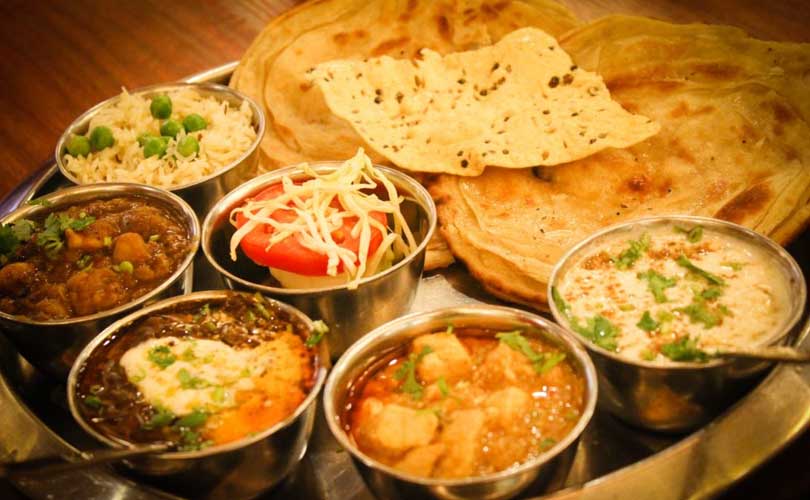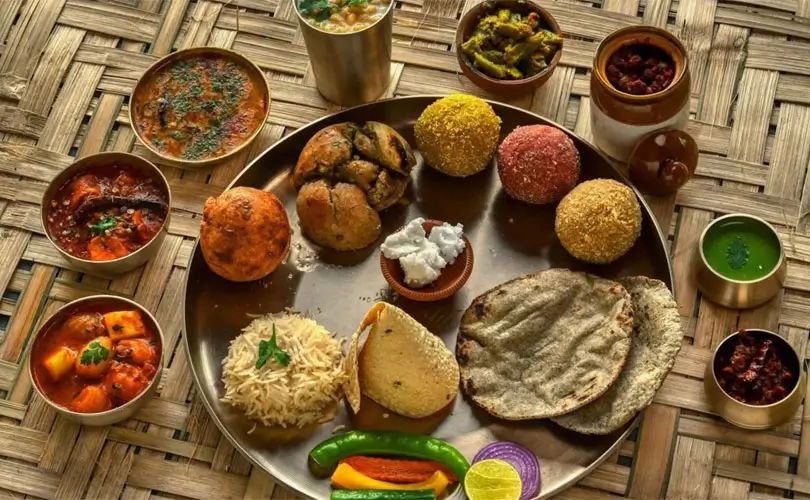
A Rajasthani thali in Jaipur is far more than a plate containing several curries. It brings together foods shaped by Rajasthan's dry climate, agricultural traditions, preservation methods, dairy culture and preference for bold spices. A properly served thali may include lentils, wheat preparations, gram-flour dishes, desert beans and berries, millet breads, chutneys, pickles, buttermilk and sweets, with each item contributing a different texture and level of richness. For an international traveler visiting Jaipur during a Golden Triangle journey, one good traditional meal can provide as much cultural context as an hour spent inside a historic market.
Jaipur offers several versions of the experience. A traveler can eat a straightforward thali in a modest vegetarian restaurant for a few hundred rupees, order a larger regional meal at a comfortable city restaurant, or spend an evening at a cultural dining venue where dinner is combined with folk performances and other activities. Current dining listings show substantial differences in price: casual Jaipur thali restaurants can serve two people for roughly ₹300-₹500, while premium cultural thali experiences can exceed ₹1,000 per adult.
The important point is that the highest price does not automatically produce the most representative food. Travelers should judge the meal by the dishes served, freshness, balance, restaurant hygiene, service style and the type of evening they actually want. Someone interested mainly in food may prefer a respected city restaurant, while a family wanting dinner together with folk entertainment may be happier spending several hours at a cultural village outside central Jaipur.
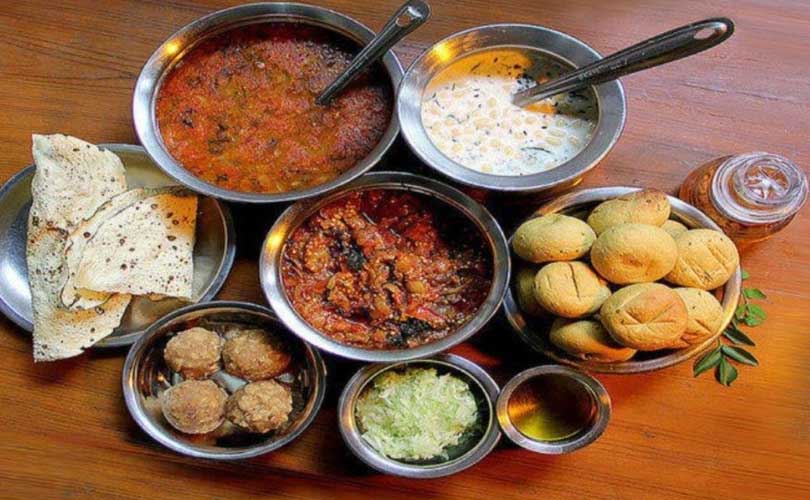
The composition of a traditional Rajasthani thali can vary from restaurant to restaurant because Rajasthan does not have one rigid plate served identically across the state. Jaipur restaurants often combine dishes associated with different parts of Rajasthan so that visitors can taste several regional preparations in one sitting. A large thali may therefore include lentils, baked wheat dumplings, sweetened crushed wheat, gram-flour curry, desert vegetables, potato or onion-based curry, millet bread, wheat bread, rice, yogurt, chutneys, pickles, papad and one or more desserts.
One of the most recognizable combinations is dal bati churma. The lentil preparation provides moisture and spice, the baked wheat dumplings bring a dense texture, and the sweet crushed wheat preparation creates contrast. The baked pieces are commonly broken open before clarified butter and lentils are added. First-time visitors sometimes make the mistake of eating the wheat dumpling dry on its own and then wondering why the dish feels heavy. It works best as part of the complete combination rather than as an isolated bread.
Another important preparation is gatte ki sabzi, made from gram-flour dumplings cooked in a seasoned gravy. This dish reflects the practical cooking traditions of a region where fresh vegetables were not always historically available in abundance. The gram-flour dumplings provide substance while the gravy may be based on yogurt and spices. The exact heat level varies considerably, so international travelers who prefer milder food should ask the restaurant before the meal begins rather than waiting until every dish has been served.
Ker sangri is particularly associated with Rajasthan's desert environment. The dish combines ingredients traditionally found in arid areas and produces a tangy, savory flavor very different from the creamy curries international visitors may associate with Indian restaurant food abroad. Chokhi Dhani's own description of its thali includes ker sangri alongside dal bati churma, gatte ki sabzi and multiple regional breads, demonstrating how central these dishes remain to commercial Rajasthani dining in Jaipur.
Breads also matter. A restaurant may serve standard wheat bread alongside bajra roti, missi roti, jowar roti or mixed-grain breads. Millet-based bread has an earthy flavor and denser texture than ordinary wheat bread. It pairs particularly well with rich curries, butter and clarified butter. Some visitors initially find the texture unfamiliar because it is less soft and elastic than refined-flour flatbreads, but that difference is part of the meal rather than a defect.
Accompaniments provide contrast. Yogurt or buttermilk can soften the effect of spices, while chutneys and pickles add acidity, heat and sharpness. Papad contributes crunch. Sweets such as churma or other regional desserts are often served alongside the savory dishes rather than only appearing after the main meal. This arrangement can surprise international visitors accustomed to a strict separation between main courses and dessert, but it allows sweet, salty, sour and spicy flavors to interact throughout the meal.
A good Jaipur Rajasthani food experience should therefore be approached gradually. Taste small portions first, identify the dishes you prefer and ask for additional servings where the restaurant provides them. Unlimited service does not mean every item needs to be eaten in large quantities. Traditional thalis can be extremely filling because several dishes contain clarified butter, lentils, wheat, gram flour and dairy.
A Rajasthani thali is more than a meal—it is a delicious introduction to the region’s culture and traditions. From dal baati churma and gatte ki sabzi to ker sangri, bajre ki roti and traditional sweets.
If a visitor has time for only one classic Rajasthani meal, dal bati churma in Jaipur is one of the strongest choices because it combines several basic elements of regional cooking in a single serving. The dish is filling, rich and built around ingredients that historically suited the conditions of Rajasthan.
The bati component consists of firm wheat dumplings that are baked until the outside develops a dry crust while the inside remains dense. Traditional service often includes generous clarified butter, which is poured over or absorbed into the broken bati. The dal is usually a seasoned lentil preparation that provides moisture and flavor, while churma is a sweet preparation made by crushing cooked wheat with sugar and clarified butter. Restaurants may use additional nuts or flavorings depending on the recipe.
The correct way to eat it does not require complicated etiquette. Break the bati into smaller pieces, add enough dal to soften it, mix according to preference and alternate savory mouthfuls with a small amount of churma. Some restaurants serve multiple varieties of lentils or additional curries alongside the main combination. Staff at traditional restaurants are generally accustomed to first-time visitors and can explain how the plate is intended to be eaten.
Portion size deserves attention. A full Rajasthani thali in Jaipur containing dal bati churma can be substantially heavier than a standard lunch. Travelers who intend to spend the afternoon walking around City Palace, Jantar Mantar and crowded markets may prefer eating the largest thali at dinner rather than immediately before several hours of sightseeing. A moderate lunch followed by a regional dinner often produces a more comfortable day.
Clarified butter is another factor. Traditional service may be generous, but a traveler does not have to accept unlimited amounts. Anyone who prefers a lighter meal can ask for less. Likewise, visitors with dietary restrictions should ask about dairy, wheat, nuts and other ingredients rather than assuming that a vegetarian thali is automatically suitable for every diet.
Pricing depends on where the dish is eaten. Casual restaurants can offer substantial meals at modest prices, while dedicated cultural venues charge more because the admission may combine food with entertainment or activities. Chokhi Dhani currently advertises a Rajasthani dinner and a Royal Thali as part of its evening offering, with its published information showing roughly ₹1,000 for the standard adult dinner and ₹1,200 for the Royal Thali, though current rates should always be checked before visiting.
For international travelers comparing several places to eat Rajasthani food in Jaipur, the best choice depends on whether the priority is the food itself or the wider evening. A city restaurant allows visitors to eat and move on, while a cultural venue can occupy several hours.
A thali becomes more interesting when a visitor recognizes what is being served instead of treating every bowl as an unidentified curry. Gatte ki sabzi is one of the easiest regional dishes to recognize once its preparation has been explained. Gram flour is seasoned, shaped and cooked before the pieces are served in a gravy. The result is substantial without depending on meat or large quantities of fresh vegetables.
The flavor can range from mildly tangy to strongly spiced depending on the restaurant. Yogurt is often important to the gravy, producing a sour note that balances the density of the gram-flour pieces. For travelers who regularly order paneer at Indian restaurants abroad, gatte provides a useful change because the texture and flavor profile are completely different.
Ker sangri should also be tasted even if its appearance is less immediately attractive than a creamy curry. The preparation reflects the ingredients of Rajasthan's arid environment and is commonly seasoned to produce a sharp, savory and slightly tangy profile. It may be served relatively dry, making it easy to eat with millet or wheat bread. For anyone interested in regional cuisine rather than generic North Indian restaurant food, this is one of the most important items on the plate.
Restaurants may also serve onion-based curries, potato dishes, lentil preparations, seasonal vegetables and gram-flour specialties. The exact selection changes according to the restaurant and meal format. A more expensive thali does not necessarily mean that every traditional dish will be present, so travelers who specifically want ker sangri or gatte should check the menu before sitting down.
Buttermilk is worth accepting unless dietary restrictions prevent it. A salty or lightly spiced chaas can be particularly refreshing with a rich thali because it provides a lighter contrast to clarified butter, lentils and wheat. Sweet yogurt drinks may also be available separately, but drinking large quantities alongside a heavy meal can make the experience more filling than expected.
Chutneys deserve similar attention. Rajasthan is known for strong accompaniments that can include garlic, chili and other intense flavors. Visitors should taste a small amount before spreading a generous spoonful across the plate. A serving that appears tiny may be deliberately small because it is designed to add concentrated flavor rather than function as a main curry.
The aim should not be to finish every bowl. A Rajasthani thali meal is best treated as a tasting structure. Begin with small amounts, return to the items you like and allow the server to refill those dishes if unlimited service is part of the restaurant's format.
Chokhi Dhani Jaipur is one of the most widely known places associated with a Rajasthani dining experience, but visitors should know that it is not simply a restaurant where they arrive, eat for forty minutes and leave. It is a cultural attraction outside central Jaipur that combines dining with performances and village-style activities, making it better suited to travelers who are willing to devote a substantial part of the evening.
The venue is located on Tonk Road toward Sitapura, away from the main historic attractions in central Jaipur. Its own published dining information lists evening operations around 7:00 p.m. to 11:00 p.m., and describes different meal formats including a Rajasthani dinner and Royal Thali. The listed foods include dal bati churma, ker sangri, gatte ki sabzi and regional breads, while the wider venue includes cultural activities such as folk performances and traditional entertainment.
Current published pricing indicates approximately ₹1,000 per adult for the Rajasthani dinner and ₹1,200 per adult for the Royal Thali, with separate child pricing based on the venue's height criteria. These figures can change, so travelers should verify the current tariff before setting out rather than relying permanently on a blog price.
The most important practical issue is time. A visit can occupy two to four hours once transportation, activities, walking and dinner are included. Community discussions from Jaipur visitors also consistently describe Chokhi Dhani as a multi-hour experience rather than a quick meal.
This makes the venue suitable for families, couples and first-time visitors who want a broad introduction to Rajasthani cultural presentation in one evening. It may be less suitable for someone with a very early departure the following morning or a traveler whose main interest is only finding the city's best-value food.
Transportation should be arranged before dinner. Because the venue lies outside the main central tourism zone, a private car in Jaipur, hotel vehicle or reliable cab is more convenient than reaching the area without knowing how the return journey will work. Travelers using a private Golden Triangle driver can ask the driver to handle the evening transfer and confirm the pickup point.
Visitors should also arrive hungry. The meal is generous, and accepting repeated servings immediately can lead to waste. Start slowly, taste each dish and request more of the items you genuinely enjoy.
Food is one of the most personal ways to understand a destination. Sit down to a traditional Rajasthani thali, discover regional specialities and experience the hospitality.
Travelers who want a substantial regional meal without dedicating an entire evening to a cultural attraction can consider Thali & More in Jaipur. The restaurant is known for vegetarian thali options and serves dishes associated with Rajasthan alongside a broader multi-cuisine menu.
Published information for its C Scheme location describes both a dal bati churma thali and a Rajasthani food thali containing more than ten items, including gatte curry, ker sangri, aloo pyaaz, several breads and churma. The restaurant is listed as operating around 11:00 a.m. to 11:00 p.m., with an approximate cost for two ranging between ₹400 and ₹1,200 depending on ordering.
That broad range is useful because it illustrates how Jaipur dining can be adjusted to the traveler's budget. Two people ordering straightforward thalis may spend relatively little, while beverages, additional dishes and desserts increase the bill. It also means travelers should look at the current menu instead of assuming that every table pays a fixed thali price.
The C Scheme location can be convenient for travelers staying in central Jaipur and is easier to fit around sightseeing than a venue outside the city. A couple could visit City Palace and Jantar Mantar earlier in the day, return to the hotel for a short break and then have a Rajasthani dinner in Jaipur without committing the entire evening to transportation and activities.
Recent Jaipur community recommendations continue to mention Thali & More positively when visitors ask specifically for Rajasthani thali options, although individual experiences naturally vary.
For first-time international visitors, the restaurant format can also be easier because staff can explain the dishes without the larger entertainment setting surrounding a cultural village meal. This gives travelers more attention for the actual food.
As with any restaurant recommendation, branches, timings, menus and prices can change. Check the current location and opening hours on the day of the meal.
Not every good Jaipur thali restaurant requires a premium budget. Natraj Thali House in Lal Kothi provides an example of a simpler vegetarian restaurant where the emphasis is on everyday North Indian and Rajasthani food rather than an elaborate tourism experience.
Current dining listings place the cost around ₹300 for two people, making it significantly less expensive than premium cultural thali venues. The Lal Kothi outlet is listed as vegetarian-friendly and serving breakfast, lunch and dinner, with current platform information showing extended operating hours.
This type of restaurant can appeal to travelers who have already attended cultural performances elsewhere and simply want a filling regional meal. It can also provide a useful contrast with expensive hotel dining. A couple paying several thousand rupees for dinner every night does not necessarily receive a more meaningful local food experience than someone eating at a busy restaurant used regularly by city residents.
The setting will generally be simpler than a luxury hotel restaurant. Travelers should select it for value and food rather than expecting palace-style interiors or an evening program. Those who care strongly about atmosphere may prefer a more polished restaurant even if the food bill is higher.
A practical advantage of lower-cost thali dining is that visitors can taste regional food without feeling obliged to finish a very expensive meal. If one preparation is too spicy or unfamiliar, the financial commitment is modest.
The restaurant also demonstrates why a Jaipur food budget should contain ranges. One traveler can spend around ₹150-₹300 per person for a straightforward meal, while another can spend ₹1,000 or more for a cultural dinner and several thousand rupees at a luxury property. Both can legitimately say they ate Rajasthani food in Jaipur, but the service style and surroundings are completely different.
A realistic Rajasthani thali price in Jaipur begins around the lower hundreds of rupees at casual restaurants and can rise beyond ₹1,000 per person when the meal is connected with a premium venue or cultural attraction. Travelers should therefore decide which kind of meal they want before comparing prices.
For a straightforward vegetarian restaurant, keeping approximately ₹250-₹500 per person available is a reasonable working range for many meals, though exact menus differ. A stronger mid-range restaurant experience may fall around ₹500-₹900 per person, particularly when additional drinks, desserts or dishes are ordered. A premium cultural meal can reach approximately ₹1,000-₹1,500 or more per adult, depending on the venue and package. Current examples range from roughly ₹300 for two at Natraj Thali House to ₹1,000-₹1,200 per adult for published Chokhi Dhani dinner options.
Hotel dining can move significantly higher. A five-star Jaipur property may charge several thousand rupees per person once beverages, taxes and service charges are included. This may be worthwhile for travelers prioritizing refined service and atmosphere, but it should not be mistaken for the only way to eat regional food.
Always read the bill before adding a gratuity. Some restaurants may include a service charge, while others do not. Taxes and beverage charges can also increase the amount beyond the price of the thali itself.
Travelers taking a Golden Triangle tour through Jaipur should ideally reserve enough money for more than one local meal. One traditional thali provides a broad introduction, while another meal can focus on individual dishes rather than repeating another enormous platter. This gives the visitor a wider view of Jaipur's food without turning every lunch and dinner into an oversized feast.
The best Rajasthani thali in Jaipur is not necessarily the restaurant with the longest menu or the highest price. The right choice depends on where the traveler is staying, how much sightseeing is scheduled that day, whether the meal is intended to be a quick lunch or a full evening activity, and how comfortable the traveler is with rich regional food. A visitor staying around C Scheme who has spent the morning at Amber Palace and the afternoon around City Palace may prefer a centrally located restaurant where dinner takes one or two hours. A family with a free evening may be happier traveling farther from central Jaipur for a cultural dinner experience.
Timing matters because a full thali can be extremely filling. Dal, bati, churma, gram-flour preparations, millet breads, rice, clarified butter, yogurt and sweets can create a much heavier meal than many international travelers normally eat at lunchtime. Having a large thali immediately before climbing through a fort or walking around crowded bazaars is rarely the most comfortable choice. Travelers with a full sightseeing schedule may prefer a lighter lunch and reserve the traditional Rajasthani dinner for the evening.
Location should also influence the decision. Jaipur's principal attractions are spread across different parts of the city. Amber Palace lies north of the old city, while many hotels and restaurants are located around C Scheme, Bani Park, MI Road and other central districts. Chokhi Dhani lies farther south on Tonk Road toward Sitapura. A restaurant that appears to be only a modest distance away on a map can require much longer in traffic, particularly during busy evening periods.
A private Jaipur driver makes restaurant logistics easier because the traveler can coordinate dinner with the day's sightseeing route. Visitors using app-based transportation should check the return journey as well as the outward trip, especially when dining outside the central city.
International travelers should also avoid trying to fit several famous restaurants into a short stay simply because each one appears on a food list. Jaipur has enough regional food that one excellent thali, one lighter local meal and perhaps one carefully selected street-food or snack stop can provide a more enjoyable experience than eating oversized meals repeatedly.
Travelers sometimes assume that a meal without meat will be less substantial, but a vegetarian Rajasthani thali demonstrates the opposite. Gram flour, lentils, wheat, millet, yogurt, clarified butter, vegetables and regional spices create a meal with enough richness and variety that meat is unnecessary.
This makes Jaipur particularly comfortable for vegetarian international travelers. A traditional thali can include several naturally vegetarian dishes without requiring substitutions. Dal bati churma, gatte ki sabzi, ker sangri, vegetable preparations, millet breads, rice, chutneys and sweets can collectively provide a complete regional meal.
Vegetarian does not automatically mean vegan, however. This distinction is extremely important for visitors with dietary restrictions. Clarified butter can be used generously on bati and breads, yogurt may form the base of certain gravies, buttermilk can accompany the meal and sweets may contain dairy. A vegan traveler in Jaipur should therefore explain the restriction clearly before ordering rather than simply requesting vegetarian food.
The same caution applies to food allergies. Gram flour is common, wheat appears throughout the meal, dairy can be widespread and some sweets may contain nuts. Anyone with a serious allergy should communicate it directly to restaurant staff and should not rely solely on identifying dishes by appearance.
Travelers who cannot tolerate very spicy food should ask for guidance. Not every Rajasthani dish is intensely hot, but garlic and chili chutneys can be powerful even when the main curry is relatively moderate. Staff can usually identify the stronger items on the plate.
One advantage of a thali is that travelers can taste a small amount before committing to a large serving. If one curry is too hot, there may be several milder items available. Yogurt, rice and bread can also balance stronger flavors.
A good restaurant should not pressure international visitors into eating beyond their comfort level. Regional food remains authentic even when a traveler asks for less clarified butter or avoids an extremely hot chutney.
A large thali can look intimidating when it arrives. Several small bowls may surround breads, rice, papad, chutneys and sweets, and traditional service can involve staff returning frequently with refills. First-time visitors sometimes accept everything repeatedly because they think refusing a refill is impolite. That usually results in unnecessary waste.
The better approach is to begin with modest portions. Taste each curry with a small piece of bread, identify which dishes you prefer and then accept additional servings of those items. When dal bati churma is served, break the bati into manageable pieces and combine it with dal and the amount of clarified butter that suits your preference. Churma can be eaten in small amounts between savory mouthfuls.
Bajra or other millet breads are generally best eaten while warm because they can become firmer as they cool. Tear off a small piece, use it with the curry and move through the meal gradually rather than trying to finish one entire dish before touching another.
Chutneys should be approached carefully. A tiny serving of garlic or chili chutney may carry more heat than a full bowl of curry. Taste it first. Pickles are similarly concentrated and are intended as accompaniments rather than vegetables to be eaten in large portions.
Rice can be kept until later in the meal and eaten with dal or a suitable curry. This allows the traveler to experience the breads first while they remain warm.
International visitors should not feel obligated to eat with their hands if they are uncomfortable doing so. Cutlery is available at established restaurants. Travelers who want to eat traditionally can use the right hand, keeping the process neat and washing hands before and after the meal.
Unlimited service should be treated as hospitality rather than a challenge. A memorable Jaipur thali experience comes from tasting the dishes properly, not from consuming the largest possible quantity.
Trying regional food is one of the strongest parts of a Jaipur visit, but travelers should still use sensible food-hygiene judgment. A restaurant should look busy, ingredients should appear fresh and cooked dishes should arrive hot. A famous name does not remove the need for ordinary awareness.
For first-time visitors to India, the biggest mistake is often changing the diet too aggressively on the first day. Someone who normally eats lightly may suddenly consume fried snacks, several rich curries, sweets and large amounts of spicy food in one evening. Even when every dish has been prepared safely, the sudden richness can be difficult for the digestive system.
A Rajasthani thali for tourists can be enjoyed more comfortably by eating slowly and stopping when full. Clarified butter can be rich, gram-flour dishes can be dense and millet breads are substantial. There is no need to finish every refill.
Drinking water should come from a trusted source. International visitors should generally use sealed bottled water or properly purified water provided by a reputable restaurant or hotel. Check the seal when opening a commercial bottle.
Travelers uncertain about ice can ask whether purified water is used. Established restaurants serving international visitors are accustomed to these questions.
Food allergies deserve more serious communication than general spice preferences. A traveler with a severe nut, dairy, wheat or other allergy should explain the restriction clearly and confirm whether cross-contact can be controlled. Traditional kitchens may use shared preparation surfaces and utensils.
Spice levels should not be confused with hygiene. A dish can be perfectly safe but still be much hotter than a visitor expects. Start with small amounts of unfamiliar chutneys and curries. Buttermilk, yogurt, bread and rice can soften strong flavors more effectively than repeatedly drinking water.
A traveler who becomes genuinely ill should seek appropriate medical assistance rather than assuming every stomach problem is a normal part of visiting India.
Jaipur usually appears after Delhi and Agra on a classic Golden Triangle itinerary, which means travelers may already have spent several days eating North Indian food by the time they reach Rajasthan. This makes Jaipur a good place to shift the emphasis from general restaurant dining toward distinctly regional dishes.
A traveler arriving from Agra by road will commonly spend several hours in transit. Scheduling a large thali immediately after checking into the hotel can work if arrival is reasonably early, but committing to a distant cultural venue after a delayed road journey may create unnecessary pressure. A central restaurant is easier on an arrival evening.
The second Jaipur evening is often better for a longer dining experience. Sightseeing can finish in the late afternoon, allowing time to return to the hotel, rest and leave for dinner without carrying cameras, shopping bags and sightseeing equipment.
Travelers visiting Chokhi Dhani should reserve several hours because the venue combines dinner with a broader cultural environment. Visitors choosing a city restaurant can generally expect a shorter evening and may have time for a walk or another activity afterward.
Lunch is another possibility, particularly for travelers who want to taste a thali but have evening commitments. In that case, keep the morning sightseeing schedule realistic and avoid eating an enormous lunch immediately before extensive walking at a fort.
Food should fit the itinerary rather than control it. A Golden Triangle food experience in Jaipur is strongest when travelers have enough time to eat slowly and understand what is being served.
From magnificent forts and heritage hotels to traditional kitchens and beautifully served thalis, Rajasthan offers an experience that engages every sense.
A traditional Rajasthani thali can contain dal, bati, churma, gatte ki sabzi, ker sangri, seasonal vegetable preparations, millet or wheat breads, rice, papad, yogurt or buttermilk, chutneys, pickles and sweets. The exact selection varies between restaurants, and some establishments serve larger regional combinations than others.
Jaipur has options across several budgets. Chokhi Dhani is suitable for travelers wanting dinner combined with a cultural evening, while restaurants such as Thali & More provide a more conventional city dining experience. Simpler establishments such as Natraj Thali House can suit travelers seeking a lower-cost meal. Menus, branches, timings and prices should be checked before visiting.
A straightforward Jaipur thali can cost roughly ₹250-₹500 per person at casual establishments, while stronger mid-range meals may cost around ₹500-₹900 per person. Cultural or premium dining experiences can reach approximately ₹1,000-₹1,500 or more per adult. Luxury hotel restaurants can cost considerably more once drinks, taxes and service charges are included.
Some dishes and particularly certain chutneys can be spicy, but the entire thali is not necessarily extremely hot. Dal, breads, rice, yogurt-based items and sweets provide balance. Visitors sensitive to chili should tell the restaurant staff and taste strong chutneys in small amounts first.
Chokhi Dhani can be worthwhile for travelers who want a broader cultural evening rather than only a restaurant meal. Its published offering combines Rajasthani food with entertainment and activities. Visitors should allow several hours and account for transportation because the venue is outside Jaipur's main historic center.
Yes. Vegetarian food in Jaipur is deeply established, and many classic Rajasthani thali dishes are vegetarian. Dal bati churma, gatte ki sabzi, ker sangri, breads, lentils and vegetable preparations can create a substantial meal without meat.
Some individual dishes can be suitable for vegans, but a standard thali may contain clarified butter, yogurt, buttermilk and other dairy products. Vegan travelers should explain their requirements clearly before ordering and confirm how individual dishes are prepared.
Break the bati into smaller pieces and combine it with dal and as much clarified butter as desired. Churma provides the sweet component and can be eaten in small amounts alongside the savory food. There is no requirement to accept excessive clarified butter or repeated refills if the traveler prefers a lighter meal.
Dinner is often more comfortable for travelers because a full thali can be heavy and may not be ideal immediately before several hours of sightseeing. Lunch works well on a lighter sightseeing day. Cultural venues operating primarily in the evening naturally suit dinner.
A first-time visitor should prioritize dal bati churma, gatte ki sabzi, ker sangri, millet breads and regional chutneys when available. These dishes provide a stronger introduction to Rajasthan's traditional food than ordering only familiar paneer or generic North Indian curries.